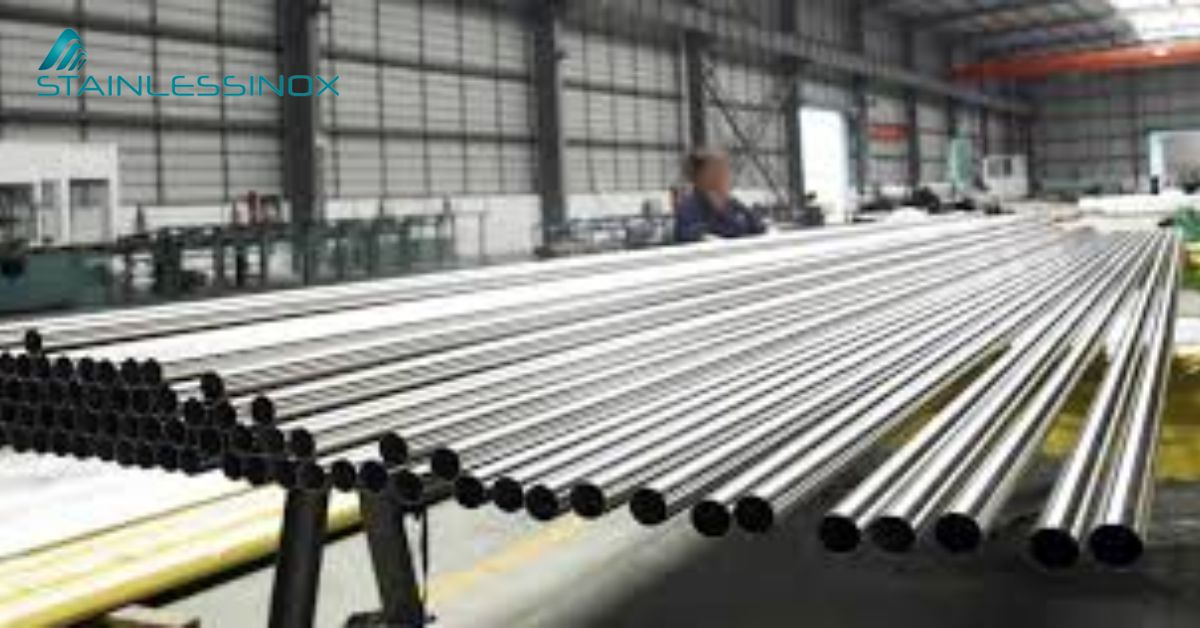
A single SS 316L pipeline can carry corrosive seawater for over 25 years without a pinhole leak. That kind of service record explains why stainless steel pipes dominate fluid and gas transport across the oil and gas, chemical, marine, and food processing sectors. At Stainless Inox, we supply these pipes daily to fabricators and contractors across the GCC, and the most common concerns about them include which type and grade actually fits the job.
What Are Stainless Steel Pipes?
A stainless steel pipe is a tubular product rolled or extruded from a steel alloy containing at least 10.5% chromium. Chromium reacts with oxygen the moment it comes in contact with air, forming a passive oxide layer just a few nanometers thick. Scratch this layer, and it rebuilds itself within hours. That self-healing film is the primary reason stainless steel resists rust where carbon steel fails.
Manufacturers add nickel and molybdenum to push resistance further, depending on grade. Pipes come in round, square, and rectangular profiles, with round sections handling pressure-bearing duty and square or rectangular sections going into structural framing and trim.
Types of Stainless Steel Pipes
Understanding the different Types of Stainless Steel Pipes and their production methods determines system compatibility; getting this selection wrong costs far more than money.
Seamless Pipes start as a solid round billet, heated to roughly 1,200°C, then pierced through with a rotating mandrel to hollow it out. No weld line means no weak point along the wall. Refineries and boiler manufacturers specify seamless pipe for lines running above 100 bar, since a continuous wall handles cyclic pressure loads without the fatigue risk a weld seam introduces.
Welded Pipes have a different manufacturing process. A flat steel strip gets rolled into a cylinder and fused along the seam using ERW (electric resistance welding), EFW (electric fusion welding), or SAW (submerged arc welding). The process costs 15-30% less than seamless production and suits low-to-medium pressure applications such as water distribution, HVAC ductwork, and structural framing.
Instrumentation/Hydraulic Tubes are smaller, typically 6mm to 50mm OD, and hold tolerances as tight as ±0.025mm. These feed pressure gauges, control loops, and hydraulic actuators where a fraction of a millimeter of variance throws off the entire reading.
Structural & Mechanical Pipes skip fluid duty. Square and rectangular sections frame vehicle chassis, support staircases, and form the backbone of architectural railings, prized as much for a clean, weld-finished look as for load capacity.
Common Stainless Steel Grades
Grade selection is where most project delays start, because a pipe that looks identical on a shelf can fail completely in the wrong environment.
SS 304 / 304L covers roughly 50% of all stainless steel pipe demand worldwide. It resists rust in air, water, and most food-grade environments, and welds cleanly without cracking. The low-carbon “L” variant resists weld decay, which is why dairy and beverage lines specify it almost exclusively. SS 304 pipes show up constantly in kitchen equipment, handrails, and architectural cladding.
SS 316 / 316L adds 2-3% molybdenum to the 304 composition, and that single change is what stops chloride ions from pitting the surface. Marine platforms, desalination plants, and pharmaceutical processing lines run on SS 316 because saltwater and aggressive chemicals destroy 304 within a few years.
SS 310 carries 24-26% chromium and 19-22% nickel, giving oxidation resistance up to 1,150°C. Furnace components, heat-treatment fixtures, and kiln linings depend on this grade where lesser alloys would scale and crack.
Titanium is used to stabilize SS 321 to prevent the precipitation of chromium carbides at the grain boundaries during long exposure to heat. Between 425°C and 815°C, this prevents the intergranular corrosion that would otherwise weaken an unstabilized grade, making SS 321 the standard for aircraft exhaust systems and high-temperature process piping.
Duplex & Super Duplex grades mix austenite and ferrite in roughly equal proportions, delivering tensile strength nearly double that of standard 316 along with superior resistance to stress corrosion cracking. Offshore platforms and subsea pipelines specify duplex where both strength and chloride resistance are non-negotiable.
Characteristics of Stainless Steel Pipes
Four key properties explain why engineers continue to specify stainless steel over alternative materials across decades of industrial use.
The chromium oxide layer in stainless steel is self-repairing, giving it a strong corrosion resistance. Another major advantage is its strength. For example, a 304 stainless steel pipe has a minimum tensile strength of 515 MPa, compared to the standard carbon steel rating of about 400 MPa. This allows for thinner wall sections without reducing pressure capacity.
Heat resistance and fire resistance are equally important. Stainless steel pipes do not lose their mechanical properties at temperatures that would soften or distort ordinary carbon steel, and the material will not burn or spread fire. Finally, stainless steel supports long-term sustainability. Scrap stainless steel can be remelted into new material without losing corrosion resistance or strength, which is why it has one of the highest recycling rates among industrial metals.
Applications of Stainless Steel Pipes
Oil and gas operators run duplex and 316 grades through upstream and midstream pipelines carrying crude, natural gas, and refined products at pressures that would split a lesser pipe within months. Chemical and petrochemical plants lean on the same resistance to handle acids, caustics, and solvents moving between reactors and storage tanks.
Marine and offshore structures will specify 316 and duplex for submerged sections that are constantly exposed to salt water spray, while food and beverage processing plants prefer 304L due to its smooth, easy-clean bore that reduces the risk of contamination. Water supply and treatment systems install stainless steel mains and treatment piping to resist the chlorine and chemical dosing used in purification, protecting drinking water quality over decades of service.
304 and 316 are used for exposed structural pieces, railings and architectural elements where weathering resistance is as important as the finish. 321 and 310 grades are used for boilers, heat exchangers and condensers, as carbon steel components would degrade in a fraction of the service life at sustained high temperatures.
Why Stainless Steel is the Go-To Choice for Piping Systems
Choosing stainless steel for a piping system comes down to a track record few materials match. The alloy tolerates extreme pressures and temperatures without the fatigue cracking that ends a carbon steel pipe’s service life early, and the self-healing oxide layer keeps transported media free of rust contamination for the system’s full design life. That combination is why the same family of grades runs city water mains in one project and a chemical reactor feed line in the next, with only the grade selection changing between them.
Conclusion
Stainless steel pipes deliver measurable performance: tensile strength above 515 MPa in standard grades, oxidation resistance past 1,150°C in 310, and chloride resistance in 316 that keeps offshore platforms running for decades. That range of grades, with seamless, welded, and structural production methods, covers nearly every demand a project can throw at a pipe.
Stainless Inox has stocked stainless steel products from our JAFZA North facility in Dubai since 2010, with warehousing across the GCC to keep delivery times short for clients in the GCC, MENA, Europe, and Asia. Our fabrication handles cuts up to 4 meters, so pipe stock arrives ready for installation. Request a quote from us today and get the grade matched to your project’s operating conditions.